EHRSQL
Clinical records
Query OMOP-format health records with validated, read-only SQL.
Preconfigured for OMOP EHRs on SQLite, MySQL, and SQL Server MedCP
MedCPA standard port for clinical and biological evidence
One read-only port for OMOP records and biomedical knowledge graphs. Run MedCP locally when sensitive work must stay inside your approved environment.
SQL and Cypher mutations are rejected before execution.
Choose the host, model, database endpoint, and network path.
Connect OMOP evidence with genes, pathways, drugs, and disease biology.
MCP standardizes how clients connect, negotiate features, and discover tools. MedCP applies it to clinical and biological data.
Overview
MedCP brings two key components into one local interface: an OMOP EHR queried with SQL and a biomedical knowledge graph queried with Cypher. Results return to the host agent that you choose.
Query OMOP-format health records with validated, read-only SQL.
Preconfigured for OMOP EHRs on SQLite, MySQL, and SQL ServerConnect diseases with genes, pathways, drugs, and other biological relationships through read-only graph queries.
Preconfigured for the SPOKE knowledge graphSystem architecture
Follow one research question from the person, through the agent host and MedCP, to the configured databases and back.
The local stdio server advertises the configured tools and rejects write-capable SQL and Cypher before execution.
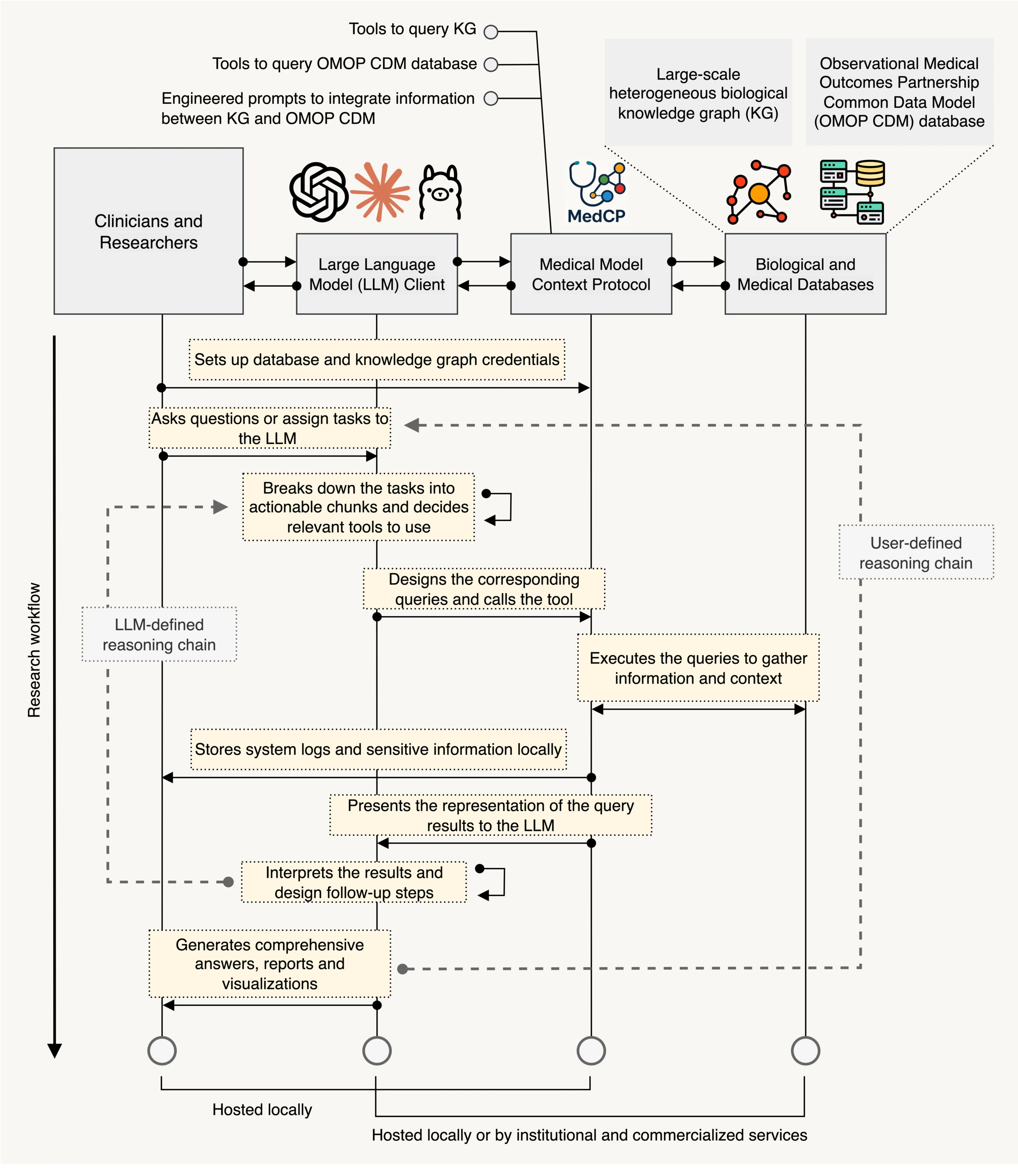
The architecture separates the researcher, host agent, local MedCP process, and the clinical and biological databases that may be local or remote.
Privacy-focused design
Pair MedCP with a local or institution-hosted model and an approved harness to build a private research environment.
A local stdio process exposes only the configured tools and rejects write-capable SQL and Cypher.
BioRouter can orchestrate local or institution-approved models. Codex CLI and Claude Code integrations are suitable only when their complete data paths are approved for the dataset.
Your institution must still manage identity, database permissions, small-cell rules, logging, retention, and exports.
MedCP supplies the read-only adapter. HIPAA compliance depends on the approved end-to-end environment and is not certified by MedCP alone.
Integrations
Every integration launches the same MedCP core. BioRouter is the canonical benchmark harness.
The canonical MedCP benchmark harness, with local orchestration and an OS-keyring path for values entered as secrets.
biorouter extension install MedCP.brxt \
  --env CLINICAL_RECORDS_BACKEND=sqlite \
--env CLINICAL_RECORDS_SQLITE_PATH=/absolute/path/database.sqliteMeasured evidence
Compare cohort-grounded answers, explore clinical and biological associations, and review local estimates beside published results.
In sickle cell disease, which infection diagnoses occur most frequently, and what immune or hemolysis processes might explain susceptibility?
The EHR-only run used diagnosis-name filters on 1,226 patients. It ranked acute chest syndrome (386) and fever (367) first, although neither is an infection diagnosis.
The fully enabled run defined 1,783 patients using standard descendants and excluded sickle cell trait. The leading infections were acute upper respiratory infection (327), pneumonia (322), viral disease (255), and urinary tract infection (239).
Observed paired GPT-5.5 benchmark example. Both panels used MedCP. This compares EHR-only with EHR + SPOKE, not an unaided model with MedCP.
Score comparison: paired t-test p=0.0026; signed-rank p=0.0040. Each condition contains the same 100 questions. Scores are the mean of physician and bioinformatician ratings on the 0 to 2 scale. Results are model and deployment specific.
The same disease pairs are measured in the EHR and SPOKE, then compared in an adjusted analysis.
A researcher asks MedCP to map comorbidity among common autoimmune and neurodegenerative diseases.
The MedCP estimate points in the same direction and its interval remains above the null.
Aggregate estimates are shown for comparison. Patient-level replication data are not included in the public repository.
Data boundary
MedCP does not make an AI host or model provider HIPAA compliant. Do not use PHI with Codex CLI, Claude Code, Claude Desktop, BioRouter, or another host unless your institution has approved the full database, host, model, network, logging, credential, and governance path.
A local or on-premises deployment can keep the research loop inside an institutional boundary when the complete environment is approved and governed.
Read the privacy guidance